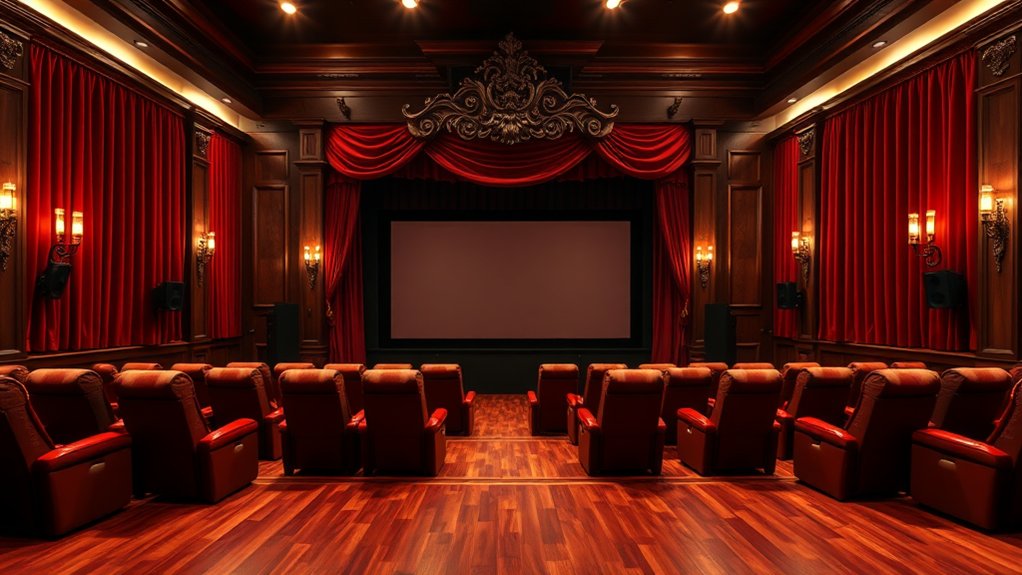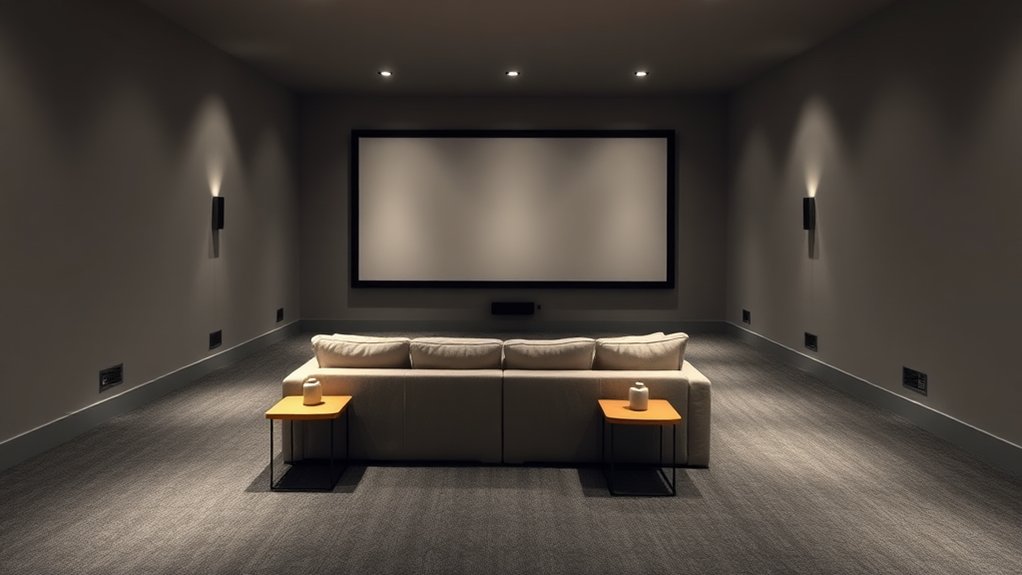

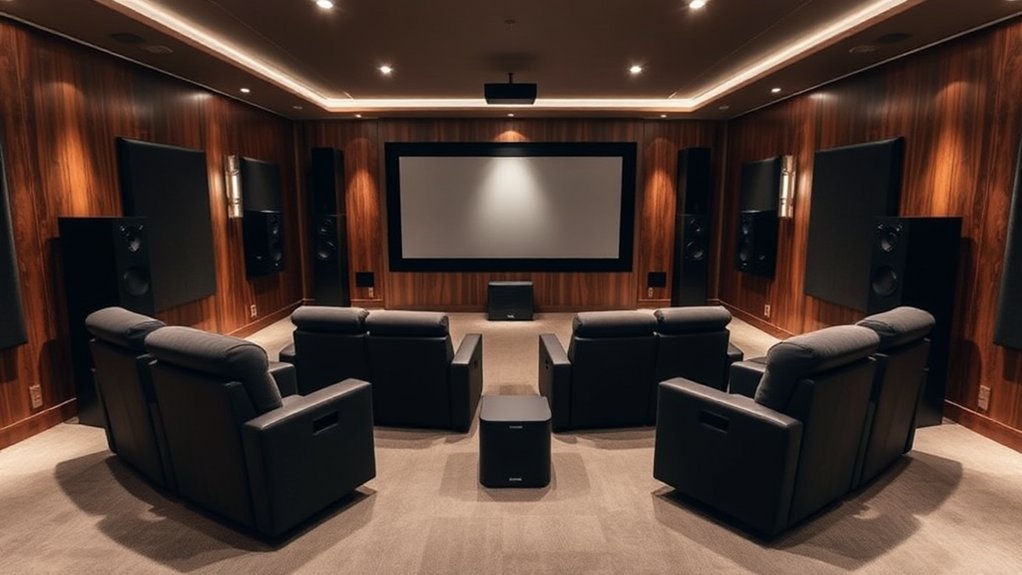
To achieve the ideal 7.1 surround sound layout, position your speakers strategically: place the center speaker at ear level, front left and right speakers form a triangle with your seating, and situate surround speakers slightly above ear level. The rear speakers should sit behind you at specific angles for maximum effect. A subwoofer thrives when placed thoughtfully to improve bass. Remember—getting the spacing just right can transform your movie nights into immersive experiences. Curious about fine-tuning? Stick around for more tips!
Key Highlights
- Position the center speaker at ear level, directly above or below the screen for clear dialogue delivery.
- Place the front left and right speakers to form an equilateral triangle with the seating, angled slightly inward.
- Side surround speakers should be at ear level, positioned between 60 to 100 degrees from the listening position.
- Rear speakers need to be placed behind the listener, at angles of 135 to 150 degrees for optimal sound effects.
- Ensure all speakers are adequately distanced from walls to reduce reflections and improve audio clarity.
Overview of 7.1 Surround Sound System
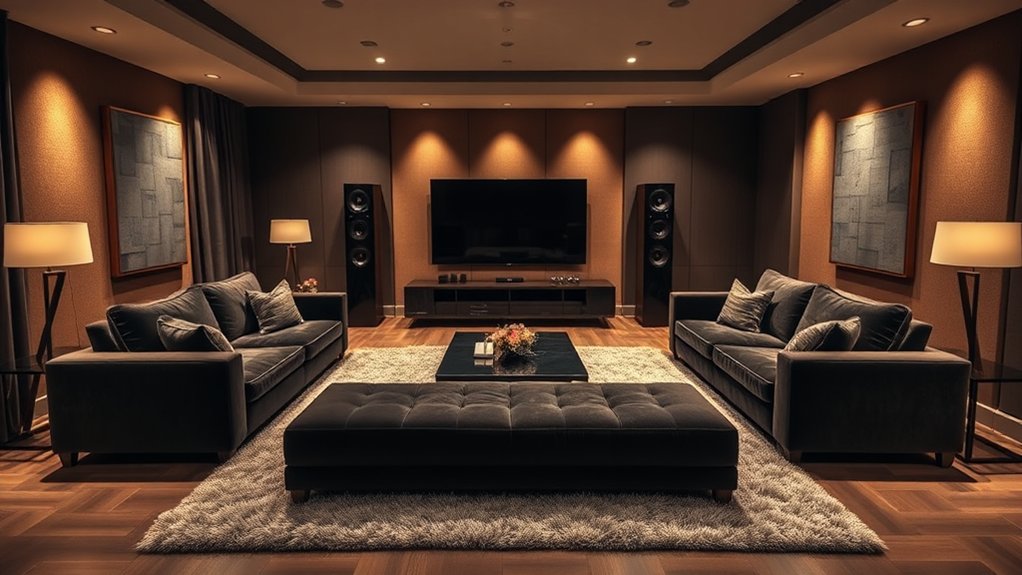
When you plunge into the world of 7.1 surround sound systems, you’re stepping into a domain designed to redefine your audio experience, whether you’re binge-watching your favorite series or immersing yourself in the latest video game.
This system consists of eight channels: front left, front right, center, a subwoofer (for that earth-shaking bass), and four more—two surround and two rear speakers. This layout includes seven speakers that work together to enhance the overall sound experience. Proper placement of all speakers is crucial for achieving optimal sound distribution; it ensures that each channel contributes to a cohesive and immersive audio experience.
Think of it as a sonic orchestra, where each channel plays its part to create a rich, immersive soundstage. This setup improves depth and clarity, letting you hear whispers in a horror movie or the distant rumble of thunder in an action flick.
Imagine a sonic orchestra where every channel collaborates to create an immersive soundstage, enriching every audio detail.
In the end, a well-configured 7.1 system makes every sound feel like it’s precisely where it should be—just like magic, right?
Ideal Speaker Placement Guidelines
What Is the Ideal 71 Surround Sound Layout?
Ideal Speaker Placement Guidelines
Now that you know the basics of a 7.1 surround sound system, the next step is figuring out where to place those speakers for the perfect listening experience.
Start with the center speaker; it should go right above or below your screen, aligned with your ear level, to guarantee crisp dialogue.
For the left and right front speakers, maintain equal distances, forming an equilateral triangle with your seating. Don’t forget to angle them inward for a focused sound. It’s also essential that front speakers should be positioned at least a couple of feet from walls to reduce reflections.
Side surrounds should sit slightly above ear level, ideally between 60 to 100 degrees from your listening position, as rear speakers belong behind you at 135 to 150 degrees. Floyd Toole suggests that side speakers should be positioned for optimal height to enhance your sound experience.
Finally, regarding the subwoofer, try placing it in a front corner for the best bass. Happy listening!
Room and Acoustic Considerations
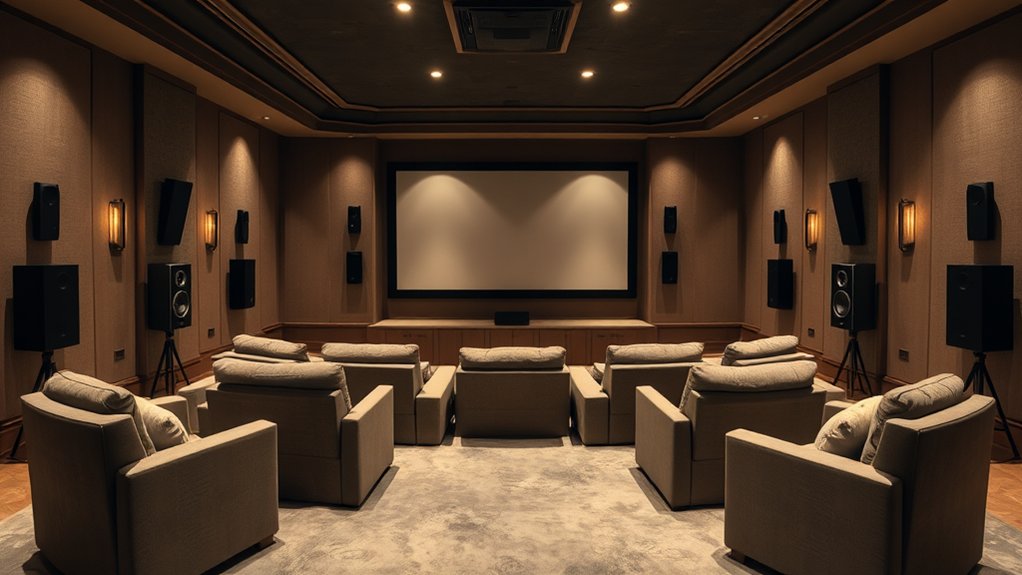
To achieve the best sound experience from your 7.1 surround sound system, you’ll need to contemplate not just where you place your speakers, but in addition the characteristics of your room itself.
First, consider that room size and shape greatly impact acoustics; rectangular rooms offer better sound reflection control than square ones. If your room has high ceilings, expect more reverberation, which means you might need some acoustic panels. Additionally, 7.1 surround sound utilizes four channels for rear sound distribution, enhancing the immersive experience when properly set.
Room size and shape significantly affect acoustics; rectangular layouts enhance sound reflection control, while high ceilings may require added acoustic panels.
Soft furnishings, like heavy curtains and plush sofas, help absorb those bothersome mid-to-high frequencies, creating a smoother sound. Additionally, avoid large open spaces—after all, sound dissipates quickly!
Finally, make certain your seating is centered with a clear line-of-sight to all speakers; the ideal position truly improves your surround sound experience.
Equipment and Connectivity Needs
Setting up a 7.1 surround sound system is like orchestrating a concert; every piece of equipment plays a crucial role in delivering a harmonious audio experience.
You’ll need a compatible AV receiver that explicitly supports 7.1 channels, offering enough power for clear audio—nobody likes distortion, right? Ergonomically managing speaker connections with high-quality cables helps minimize signal loss.
You require eight speakers and a subwoofer, ideally matched by brand for that seamless sound. For devices like Blu-ray players or game consoles, make certain they output multi-channel audio.
Furthermore, don’t forget about Wi-Fi and Bluetooth capabilities for streaming; after all, who wouldn’t want their music at the touch of a button? Additionally, consider integrating components with a stable Wi-Fi connection to ensure optimal performance during playback.
With everything connected properly, you’re all set for audio bliss!
Advanced Configurations and Expandability
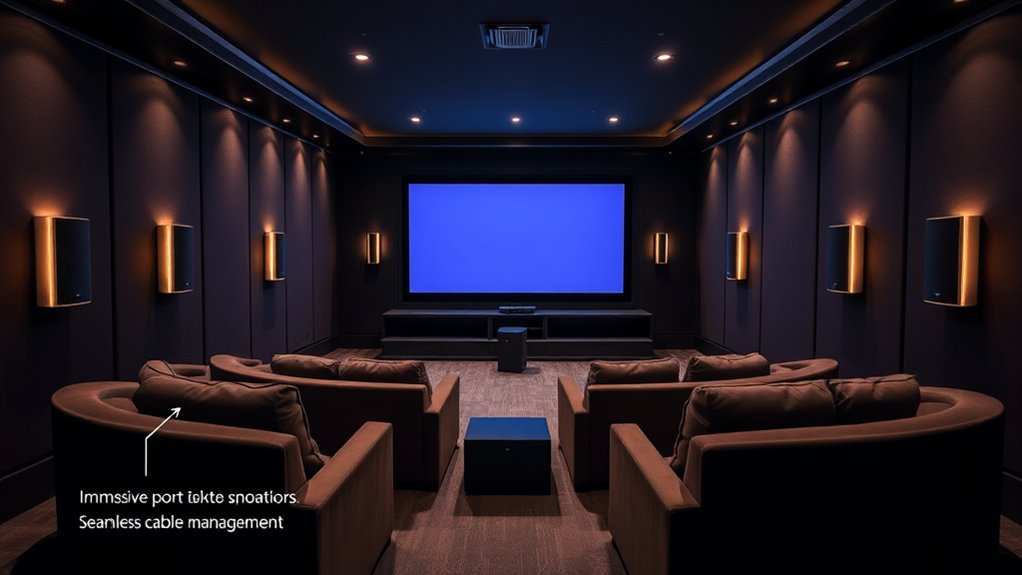
Though you may think that a standard 7.1 surround sound layout is sufficient for your audio needs, investigating advanced configurations can take your listening experience to new heights.
By customizing speaker placement, you can optimize sound quality based on your room’s unique acoustics—think of it like tailoring a suit for the perfect fit. If you’re adventurous, expanding to Dolby Atmos adds overhead speakers, elevating your audio game.
It’s like having a surround sound experience that literally surrounds you! In addition, future-proofing your setup is crucial; ensuring compatibility with emerging technologies means you won’t feel outdated.
With options to scale up and fine-tune, your system can adapt as your audio cravings evolve. Compact designs such as those found in soundbars like the Sonos Beam and LG S90QY help maximize space without compromising on sound quality. Who said home theater couldn’t be a dynamic adventure?
Calibration and Testing Techniques
Calibration and testing aren’t just optional steps in creating a superior 7.1 surround sound setup—they’re essential for unlocking your system’s full potential.
You’ll want to use automatic calibration systems, which employ built-in microphones to analyze your speaker setup, adjusting distances and volume for even sound output. Ensuring your speakers are at seated head height will help you achieve accurate sound projection, and tools like decibel meters (or smartphone apps) make fine-tuning a breeze. Additionally, prioritizing sound quality and immersion through careful adjustments can dramatically enhance your movie-watching experience.
Test tones are your best friends here; they check individual speaker output and timing. Listening closely to various audio can reveal issues you mightn’t catch at first. So, why leave sound quality to chance when a little calibration can turn your living room into an audio paradise?
Common Challenges and Solutions
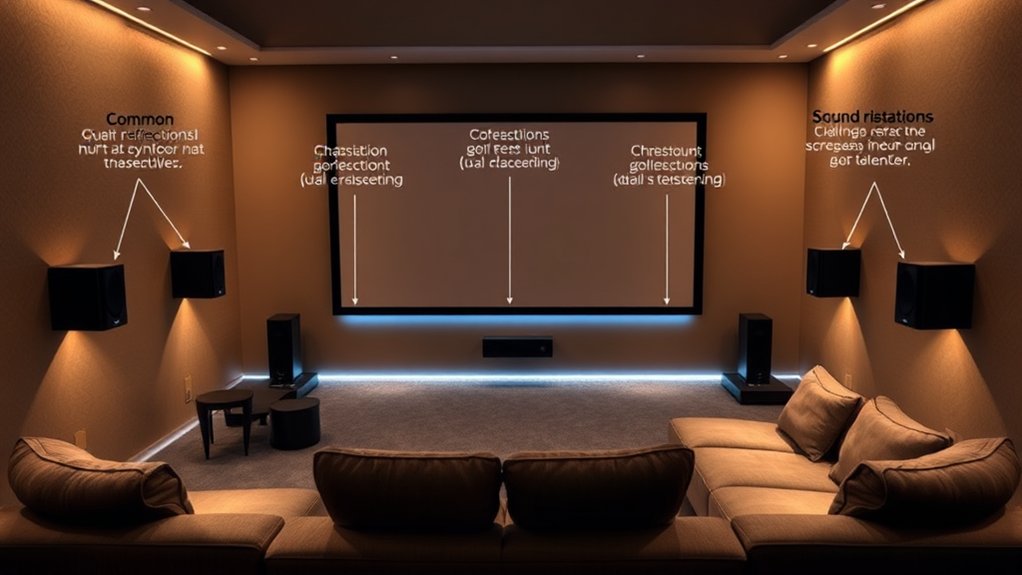
Creating the perfect 7.1 surround sound experience can feel like assembling a complex puzzle; yet, once you understand the common challenges and solutions, it can actually be quite rewarding.
Speaker placement is critical; front speakers should be at ear level, whereas surround speakers hover slightly above. In small rooms, achieving symmetry can be tricky, but it’s essential for balanced sound.
If your audio tracks are mixed only for stereo or 5.1, don’t fret—your AV receiver likely has upmixing options, though results can vary.
Regarding acoustics, consider soft furniture to eliminate echoes.
Finally, make certain your wiring is solid; a simple reversed connection could throw off your setup completely. You don’t want to miss that booming bass, right?
Frequently Asked Questions
What Are the Benefits of Using a 7.1 System Over 5.1?
A 7.1 system improves your audio immersion with two additional rear speakers, creating a fuller sound field. You’ll enjoy more realistic spatial positioning and richer atmospherics, especially in larger rooms, elevating your overall audio experience.
Can I Use Existing Speakers for a 7.1 Setup?
Absolutely, you can use existing speakers for a 7.1 setup! Just verify they match in timbre and compatibility with your receiver. Proper placement and calibration will improve your overall audio experience considerably.
What Types of Cables Are Recommended for Optimal Performance?
For maximum performance in your 7.1 surround sound system, use high-speed HDMI cables to guarantee quality sound and video. If you’re using analog, stick with oxygen-free copper cables and proper gauge to maintain clarity.
How Does Room Shape Affect Sound Quality in 7.1 Systems?
Room shape substantially impacts your 7.1 system’s sound quality. Irregular layouts complicate speaker placement and sound pathways, whereas parallel walls can create unwanted reflections, negatively affecting clarity and immersion. Proper positioning and treatment are crucial for ideal performance.
What Common Mistakes Should I Avoid When Setting up 7.1 Surround Sound?
When setting up 7.1 surround sound, avoid common mistakes like poor speaker placement, ignoring room acoustics, and uneven distances. Make certain speakers point toward your listening position for the best clarity and immersive experience.