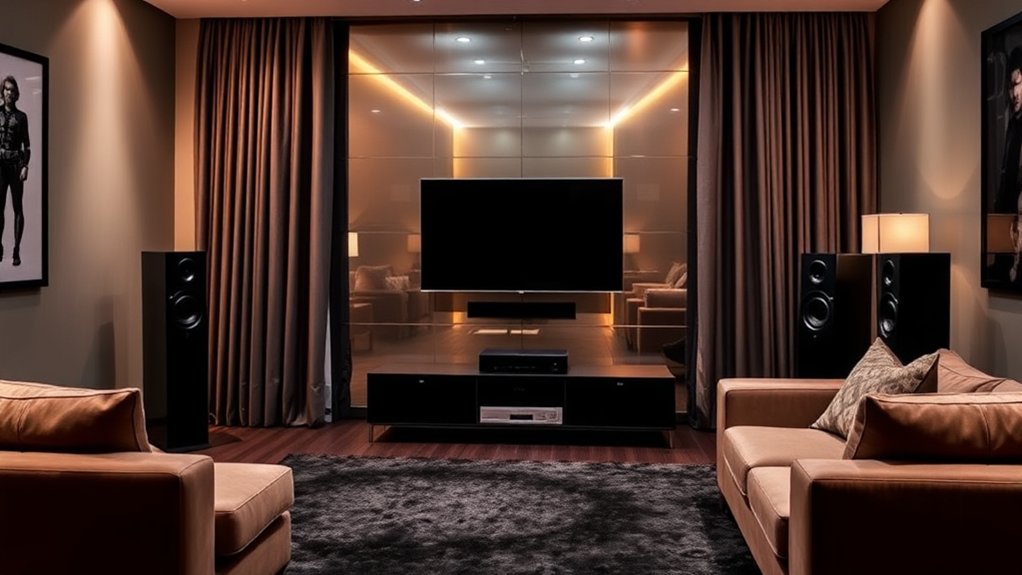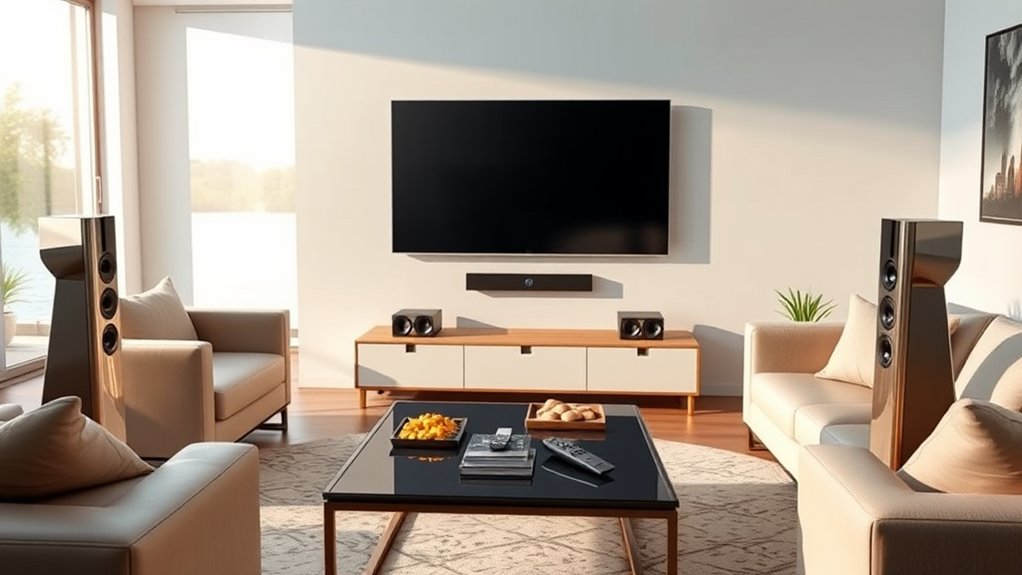

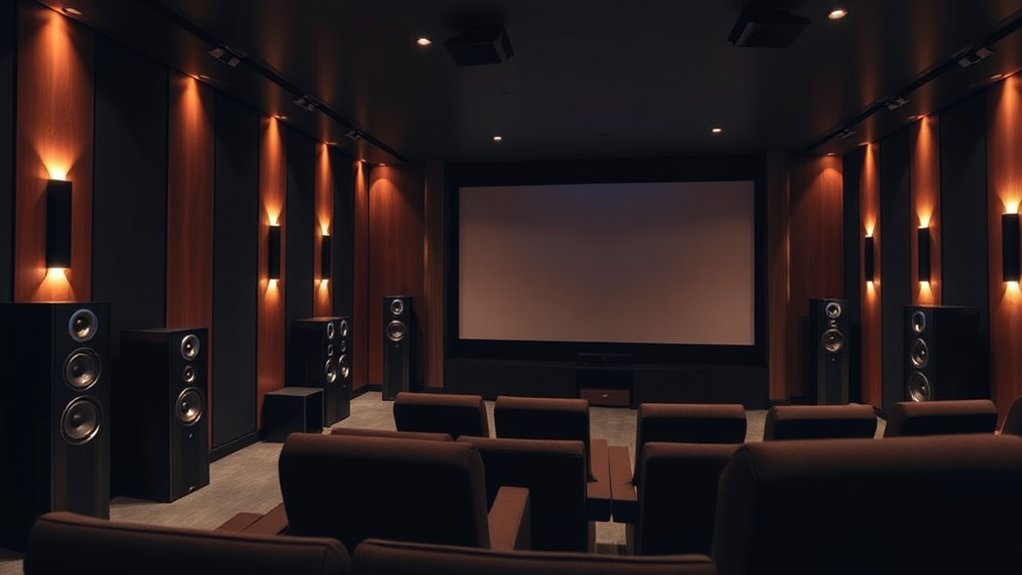
When choosing immersive home theater speakers, first consider your room size and acoustics—small spaces benefit from compact speakers, whereas larger rooms need powerful ones for full sound. Next, decide on a speaker configuration that fits your setup, like a 5.1 or 7.1 system for surround sound. Don’t forget to match your amplifier’s power with speaker specs for the best performance. Place your speakers thoughtfully, and investigate brands that deliver quality sound. Curious about more tips?
Key Highlights
- Choose speakers with Dolby Atmos support for an enhanced immersive audio experience that captures detailed sound dynamics.
- Ensure your amplifier’s power output aligns with the speakers’ RMS rating to avoid distortion and ensure clear sound quality.
- Select a balanced configuration like 5.1 or 7.1 for optimal surround sound effects tailored to your room’s dimensions.
- Invest in quality front speakers for clear dialogue and sound accuracy; prioritize brands known for reliability and performance.
- Experiment with speaker placement, angling front speakers inward, and positioning surround speakers slightly behind for a broader soundstage.
Understand Your Room Size and Acoustics
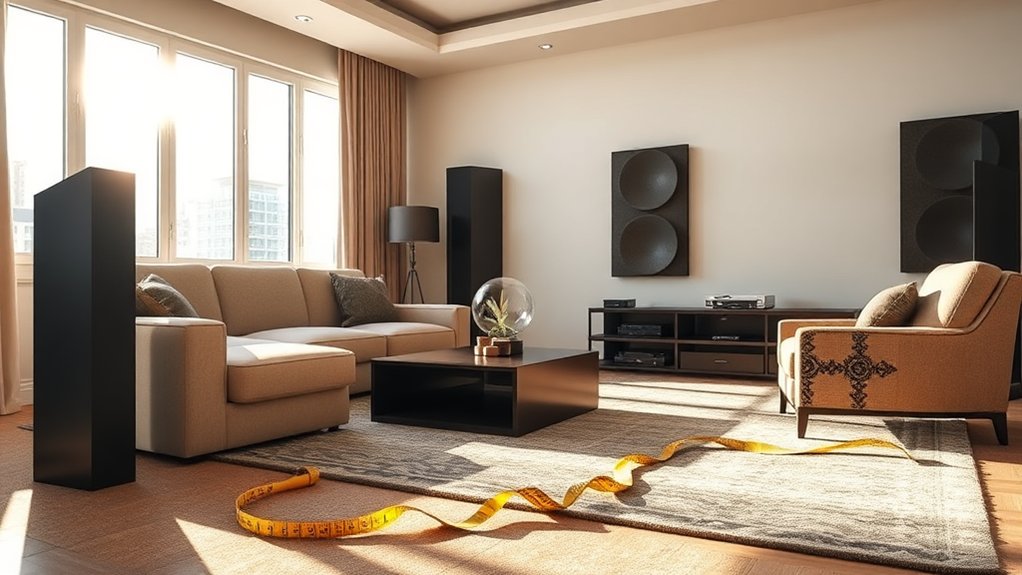
When you’re setting up a home theater, understanding your room size and acoustics is critical; after all, it’s like trying to make a gourmet meal in a shoebox kitchen. Large rooms with high ceilings usually need bigger or more powerful speakers; otherwise, you might end up with sound that feels weak. Conversely, in smaller spaces, you’re better off with compact speakers—they offer balance and clarity, preventing your audio from being overpowered. It’s important to remember that your budget affects the size of your setup as well. Additionally, sound quality is enhanced when you consider channel configuration to suit your room’s dimensions. Don’t forget the shape of your room! Rectangular rooms optimize sound control, whereas square ones can cause unwanted reflections. If your dimensions stray from the golden ratio, you might need acoustic treatment to avoid distortion. Measuring both speakers and subwoofers is essential for getting a full-bandwidth assessment of your audio setup. Proper sizing and treatment truly improve your listening experience, turning your space into an immersive haven.
Determine Your Speaker Configuration
Choosing the right speaker configuration for your home theater can feel a bit like selecting the perfect ingredients for a gourmet dish; each component plays a crucial role in crafting a delightful audio experience.
You’ve got options, like the 5.1 setup, which balances sound quality with space efficiency, or the 7.1 configuration, perfect for longer rooms that crave improved surround effects. The 5.1 surround sound formats, such as Dolby Digital, provide an immersive audio experience that enhances movie watching.
For those after a more immersive experience, consider 9.1 or even 11.1 configurations, which bring height effects into play. Surround sound speakers create dimensional audio, ensuring that the sound envelops you from various angles for a truly immersive viewing experience. Evaluating room characteristics is essential to ensure your chosen configuration functions optimally with your space.
Just like a well-prepared meal, your configuration should cater to your space. With surround speakers enveloping you in sound and a subwoofer thumping under your feet, it’s all about how these components come together.
Choose the Right Speaker Types
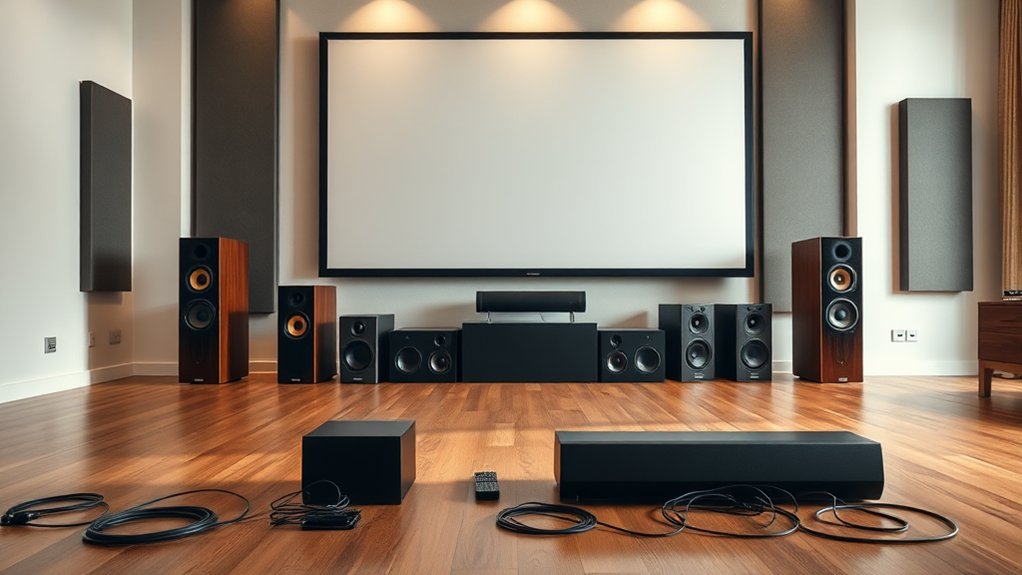
Selecting the right types of speakers for your home theater can feel like assembling a musical ensemble, where each piece plays its part to create a harmonious audio experience. Start with floor-standing speakers, the towering giants that deliver rich bass and expansive sound. If space is tight, bookshelf speakers offer versatility without compromising sound quality. Don’t forget the center channel speaker, your go-to for clear dialogue, placed right under or above the screen for ideal alignment. Surround sound speakers add that immersive touch, transporting you right into the action, as subwoofers handle the deep bass, shaking the room during intense scenes. Additionally, managing data effectively can enhance your overall planning process, similar to how choosing the right speaker types optimizes the home theater experience. To create an immersive movie experience, consider incorporating audio technologies such as Dolby Atmos for enhanced depth and surround sound capabilities.
Match Amplifiers and Speaker Specifications
Imagine settling down for movie night, popcorn in hand, only to realize your home theater setup isn’t delivering the lively soundscape you hoped for. To prevent this, matching your amplifier and speakers is key.
First, check speaker impedance—common values are 4Ω, 6Ω, and 8Ω. Most amplifiers perform best with an 8Ω load. If your speakers dip below the amplifier’s minimum impedance rating, you risk damaging your gear.
Next, match your amplifier’s power output to the speaker’s RMS rating; ideally, the amp should provide around twice the RMS for distortion-free sound. Additionally, consider speakers that provide Dolby Atmos support for a more immersive experience.
Finally, confirm your amplifier’s channel count aligns with your speakers for peak performance. After all, who wants to miss dramatic audio moments just due to mismatched specs?
Consider Your Listening Preferences
Understanding your listening preferences is a key step in getting the most from your home theater experience.
If you’re a movie buff, consider a 5.1 or 7.1 surround sound system to truly feel the action, whereas music lovers might lean toward a simpler 2.0 or 2.1 setup that offers crisp audio with balanced bass.
Gamers can immerse themselves in gameplay with surround sound for improved spatial awareness.
Surround sound elevates gaming, enhancing spatial awareness and immersing players in the action like never before.
And let’s not forget those thrilling sports moments—having a solid center channel speaker is vital to guarantee you catch every play-by-play detail.
In the end, knowing how you consume content helps you choose the right configuration, augmenting both enjoyment and clarity. For instance, a deep, powerful bass response can significantly enhance the audio experience, allowing you to fully engage with your favorite soundtracks and sound effects.
After all, who wants to miss out on dialogue in their favorite shows?
Set a Realistic Budget
Though a high-quality home theater setup can improve your viewing experience, setting a realistic budget is crucial to avoid financial pitfalls.
Start by understanding that basic systems range from $500 to over $2,000, whereas high-end setups can easily run from $3,000 to $10,000 or more.
Prioritize spending on the front three speakers, allocating around $500 each, since they deliver most of the dialogue.
Don’t forget the subwoofers—at around $1,000 each, two subs can greatly enhance bass.
Consider your installation needs too; professional help can increase costs.
As you balance your budget against desired features, ask yourself: how immersive do you want your home theater experience to be?
It’s all about finding that sweet spot!
Research Speaker Brands and Models
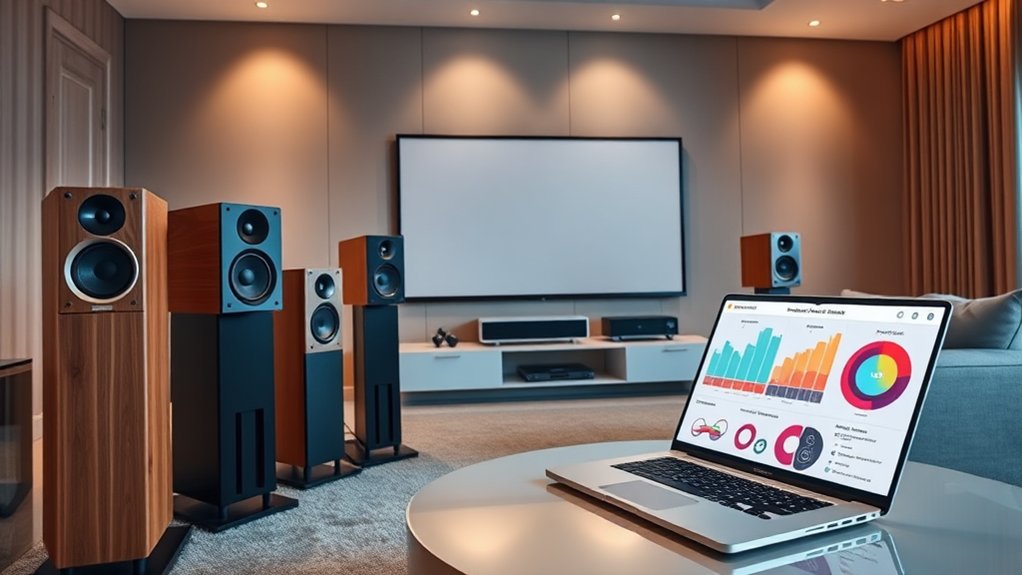
Once you’ve got a budget in mind, the next step is to explore the vast scenery of speaker brands and models that can improve your home theater experience.
Popular names like Dynaudio, Focal, and Bowers & Wilkins stand out for their impressive sound quality, whereas Sony and Bose offer great options for those seeking ease of use.
When looking at models, don’t overlook configurations such as the Sony HT-A9 with its advanced spatial sound mapping.
Consider support for surround sound formats, like Dolby Atmos, which can raise your movie nights.
Remember, a reputable brand usually provides better reliability and post-purchase support—so don’t just choose based on price.
After all, a great speaker can make you feel like you’re right in the action, right?
Experiment With Speaker Placement
In regard to creating the perfect home theater experience, experimenting with speaker placement is crucial—after all, even the best equipment can fall short if not positioned correctly.
Start by positioning your center speaker just above or below the TV, ideally below, to guarantee sound aligns with visuals, as you position your primary seating directly in front.
Now, for those front left and right speakers, aim to form an equilateral triangle with your listening area, angling them inward for a fuller soundstage.
Don’t forget to place surround speakers slightly behind you for that immersive feel.
It might feel like a puzzle at times, but with some trial and error, you’ll find the sweet spot for clear dialogue and strong audio immersion. Additionally, using speakers with Tractrix Horn technology can further enhance the directional sound clarity, making your audio experience even more immersive.
Utilize Calibration Tools for Optimal Sound
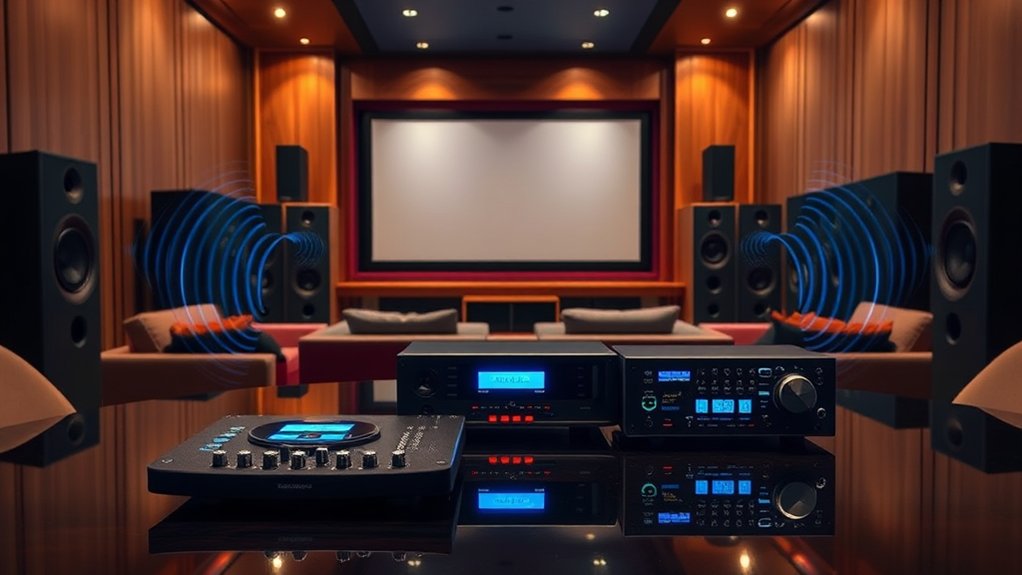
When you plunge into the world of home theater audio, using calibration tools can feel like unlocking a secret level in a video game—suddenly, everything sounds incredible.
By utilizing a sound level meter and calibration microphone, you can accurately measure volume and optimize your speaker setup.
Imagine having a tiny audio assistant ready to fine-tune frequency responses and adjust delays, ensuring your sound is perfectly synchronized.
Don’t forget to use a tripod to position that microphone at ear height—every detail matters!
Test tone generators embedded in your AV receiver can guide you through the calibration process, making adjustments a breeze.
Plan for Future Upgrades and Expandability
Getting the most out of your home theater experience doesn’t just stop at calibration; it’s important to think ahead about how your system can grow with your needs.
Start with a high-quality AV receiver that supports multiple audio formats, like Dolby Atmos, and invest in front speakers that deliver rich sound, making future integration easier.
Consider modular surround setups for gradual expansions—think going from 5.1 to 7.1 without breaking a sweat.
Verify your speakers use standardized connectors; this way, you won’t need a degree in engineering to add more.
And remember, planning for wiring—either wired or wireless—will save you headaches when you’re ready to improve your immersive experience. Additionally, choosing speakers that support Dolby Atmos will further enhance the cinematic quality of your home theater.
After all, who doesn’t want an upgrade-ready theater?
Frequently Asked Questions
How Do I Know if My Speakers Are Compatible With My TV?
To know if your speakers are compatible with your TV, check connection types like HDMI, optical, or Bluetooth. Additionally, verify audio format support, and guarantee both devices can communicate effortlessly for the best audio experience.
Can I Use Outdoor Speakers for My Home Theater Setup?
You can use outdoor speakers for your home theater setup, but their performance may lack the detailed sound staging you’d expect. They prioritize volume and durability, which might not improve your viewing experience as much.
What Features Should I Look for in Soundbars?
When choosing soundbars, you’ll want features like surround sound support, HDMI inputs for multiple devices, and wireless connectivity. Look for options that improve bass, guarantee voice clarity, and fit your room’s dimensions perfectly.
Are Wireless Speakers as Effective as Wired Ones?
Wireless speakers can be effective, but you may experience audio compression, interference, and latency issues. If sound quality’s your priority, wired speakers typically deliver clearer audio and wider dynamic ranges, making them a more reliable choice.
How Do I Clean and Maintain My Speakers?
To clean and maintain your speakers, unplug them first, gently dust with a microfiber cloth, and avoid harsh chemicals. Regularly perform deep cleanings and inspect components to guarantee longevity and peak sound quality.